
Introduction
A not-for-profit healthcare system found that adherence to clinical quality observed metrics for inpatient heart failure discharge instruction was consistently below national standards. Working toward a goal of increasing the observed rate of compliance from 45.3% to at least 90% by January next year, the improvement team utilizes the Six Sigma DMAIC (define, measure, analyze, improve, control) method and Pareto analysis to identify potential failures and the vital factors contributing to the problem.
Strategies developed to address vital signs and improve the process included standardizing discharge across all nursing units, improving unit-by-unit knowledge of heart failure discharge instruction elements through one-on-one training, and simplifying the heart failure discharge instruction process. The project succeeded in reaching its goal.
Tools & Techniques to Improve Quality
The first tool used in operations management to improve quality is a quality audit. This is an independent expert assessment that determines how well the project’s operations comply with, and whether they comply with, the rules, processes, and procedures established within the project or organization (Kammoun, Hachicha, and Aljuaid, 2021). The purpose of the quality audit is to identify inefficient and economically unjustified rules, processes, and procedures used in the project (Kammoun, Hachicha, and Aljuaid, 2021). The number and timing of planned project audits can be determined by the project’s main stages or key events. For example, in this case, the not-for-profit healthcare system can audit the care of inpatient heart failure patients.
The second tool improving quality in operations management is the Six Sigma DMAIC approach. Six Sigma is an organized, parallel, mesostructured approach that enables reducing variation in organizational processes through the use of improvement specialists, a structured method, and performance indicators to achieve strategic goals (Kammoun, Hachicha, and Aljuaid, 2021). It is a methodology for developing products and processes that work at a high level, as well as a quality philosophy and management technique.
In this case study, the use of the Six Sigma DMAIC approach enabled examination of the medical service process at each stage to identify the cause of an insufficiently positive patient outcome. For example, at the define stage, the problem of non-compliance with medical standards was identified. Furthermore, during the measurement stage, the discrepancy indicator was expressed as a percentage. After that, it will be necessary to analyze their potential causes, improve them, and monitor compliance with new practices that promote positive changes.
The third tool used to improve quality in operations management is the Pareto chart, which allows for the distribution of effort to resolve emerging problems and identify the main reasons to act. There are two types of Pareto diagrams: by results and by reasons (Kammoun, Hachicha, and Aljuaid, 2021). For example, in relation to this case study, it would be appropriate to compile both Pareto diagrams. The results chart will indicate which patient outcome is observed, and the reasons chart will indicate what led to it. This tool is designed to identify the main problem and will reflect the undesirable results of medical activity.
Lean Management Tools
In this case study, lean management tools will be beneficial to the hospital as they will target the problem in several ways. First, it will ensure the provision of defect-free medical services (Makwana and Barrett, 2019). As a result, patients will perform better at discharge. Moreover, the use of lean management tools will help reduce or eliminate losses and increase efficiency (Makwana and Barrett, 2019). Therefore, due to improved financial literacy, the necessary drugs and manipulation tools for patients will be purchased.
Lean management tools are used to increase patient and healthcare worker satisfaction. With their help, nurses will be able to avoid burnout and perform their jobs more effectively by caring for patients more effectively (Makwana and Barrett, 2019). Lean management tools play an important role in improving the safety of medical activities, therefore. At the same time, in the hospital, patients will be less likely to be subjected to medical error, which will worsen their performance at discharge.
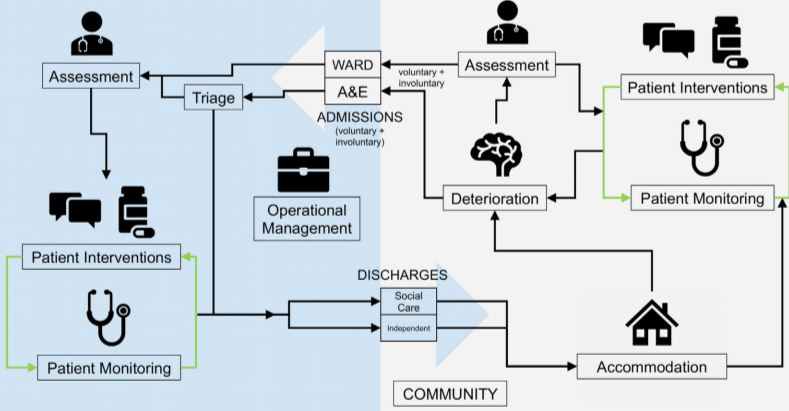
In general, the use of lean management tools will support lean patient flow from admission to discharge. The patient flow process is shown in Diagram 1, and it can be used to identify the main steps that lean management tools affect (Dawoodbhoy et al., 2021, p. 9). As seen in the patient’s hospital path, the optimal workload of the component is determined by the ratio of two opposing requirements (Dawoodbhoy et al., 2021, p. 9). First of all, this is to minimize the average waiting time for a patient to be hospitalized or a similar characteristic – the average length of the queue for hospitalization in the Admission position (Dawoodbhoy et al., 2021, p. 9).
The second point is the occupancy of the bed – the quotient of the bed’s occupancy time over a period. This value is inversely proportional to the amount of bed downtime, so this requirement can be formulated as minimizing the average bed downtime (Dawoodbhoy et al., 2021). According to Diagram 1, the intermediate point and the missing link are operational management, which is influenced by the implementation of lean management tools. Their use will help minimize average patient waiting time and more efficiently use beds, thereby improving patient flow from admission to discharge.
Smooth & Effective Patient Discharges
Several key factors hinder smooth, effective patient discharges in any healthcare setting. It is necessary to consider the impact of negative behavior, both by medical workers and by patients, on the recovery process and the duration of hospitalization. Results of studies confirm that the speed of recovery and the desire to follow a doctor’s advice are directly determined by how a patient perceives a doctor and a nurse (Dawoodbhoy et al., 2021). At the final stage of inpatient treatment, patients have other problems(Dawoodbhoy et al., 2021).
The patient is afraid to leave the hospital and remain without constant supervision by doctors and nurses. Passive, phlegmatic individuals experience great psychological difficulties at the stage of completion of treatment. Some patients fear being left without the usual medical care after hospital discharge (Dawoodbhoy et al., 2021). Sometimes they seek to prolong their stay in the hospital, and with it, the state of psychological security. In studies, this factor was indicated by 14% of the surveyed patients (Dawoodbhoy et al., 2021). Conversations and classes with the patient during his hospital stay help address the problem, explaining what can happen after discharge and how to prevent or manage it.
The relationship between health workers and patients’ relatives is also a factor in patient discharge and should be determined solely by prioritizing the patient’s interests. It must be remembered that information about the patient’s condition is provided only with the patient’s consent. It is necessary to inform the patient’s relatives and the patient himself about new treatment methods and disease prevention strategies (Dawoodbhoy et al., 2021).
This shows the patient that they are directly involved in the treatment of the disease, increases their self-esteem and motivation for successful interaction with medical staff, and supports compliance with the medical regimen necessary for successful treatment completion and timely discharge (Dawoodbhoy et al., 2021). Training medical personnel to educate and support patients and their relatives positively affects patients’ adaptation to inpatient treatment and discharge. Their participation in post-inpatient treatment and discharge helps ensure a smooth transition.
Lean & Six Sigma Application
Both Lean Manufacturing and Six Sigma originated in industrial production. Since then, they have spread worldwide and been adopted across several industries, including medicine. Six Sigma helps reduce deviations in production processes by eliminating errors that cause defects in products or services. The term Six Sigma refers to achieving a state in which there are approximately 3.4 defects per million opportunities (Makwana and Barrett, 2019).
Lean manufacturing offers tools and techniques that aim to eliminate production losses. Each aspect of production operations is studied in detail, and the processes that add value are separated from the processes that are not related to creating value from the point of view of the end user, that is, the patient (Makwana and Barrett, 2019). Thus, these two tools help to achieve the same goal of improving healthcare operations in different ways.
Six Sigma focuses on the study of processes to identify errors that lead to defects in products or services. Lean management focuses on identifying and eliminating losses in the process of work. This includes detailed planning of the operation to identify the problem, and then reviewing each aspect of the operation through the eyes of the end user (Makwana and Barrett, 2019). Therefore, the key difference between the approaches is their focus: Six Sigma explores problems from the perspective of the healthcare institution and its employees, while lean management explores them from the perspective of the patient.
Reference List
Dawoodbhoy, F. M. et al. (2021) ‘AI in patient flow: Applications of artificial intelligence to improve patient flow in NHS acute mental health inpatient units’, Heliyon, 7(11), pp. 1–18.
Kammoun, A., Hachicha, W. and Aljuaid, A. M. (2021) ‘Integrating quality tools and methods to analyze and improve a hospital sterilization process‘, Healthcare, 9(544), pp. 1–13.
Makwana, A. D. and Patange, G. S. (2019) ‘A methodical literature review on application of Lean & Six Sigma in various industries‘, Australian Journal of Mechanical Engineering, 19(1), pp. 107–121.
