Introduction
Patients who have lost their ability to move, either temporarily or permanently, are at higher risk of developing several conditions, including muscle atrophy, decreased circulation, urinary and bowel issues, and pressure ulcers. The latter is a serious burden for patients and caregivers, both physically and mentally (Al Mutair et al., 2020; Yang et al., 2020). Therefore, it is of utmost importance to prevent this complication in immobilized acute clients. The present paper provides a description of previous practices applied to the issue, the rationale for change, and updated approaches in medical-surgical nursing.
Practices and How They Impacted the Medical-Surgical Unit
Traditional practices for pressure ulcers include pressure relief, repositioning the patient, wound cleaning and dressing, and infection control. Among the factors influencing the development of pressure injuries are intensity, duration, and tolerance threshold (Tyerman & Cobbett, 2022). The approaches to mitigating the negative consequences depend on these factors. The primary method of alleviation is relieving pressure on the affected area. This can be done by repositioning the patient to minimize prolonged pressure on the same area. The choice of bed and mattress surface is also important, as reactive air surfaces have been reported to promote healing (Shi et al., 2021).
Wound cleaning is another essential method of preventing pressure ulcer development and infections. Nurses can also apply dressings to the wounds to create a moist healing environment (Avsar et al., 2021). The North American Nursing Diagnosis Association (NANDA) acknowledges the risk of infection as one of the core nursing diagnosis domains (“Health-conditions for all your healthcare needs,” n.d.). Therefore, infection control is a crucial step in pressure injury management, as without proper wound monitoring for infection, the situation can deteriorate.
While each of these practices has proven effective, the prevalence of pressure ulcers calls for new ways to prevent their development in immobile patients. Therefore, it is necessary to develop new solutions that benefit both patients and healthcare institutions by improving health indicators. The primary need for change is to reduce the time for complete pressure injury healing and, thus, increase patient satisfaction and their overall well-being. The other rationale behind the change is to reduce the duration of admission, as pressure ulcers considerably prolong it (Tyerman & Cobbett, 2022). It is impossible to replace traditional approaches altogether, but it is relevant to introduce new ways to prevent and treat the issue under consideration to achieve the best outcomes.
Modern approaches to managing pressure ulcers are still based on common practices. However, scholars and practitioners increasingly discuss the need for innovative aspects of treatment and prevention. Alderden et al. (2020) and Al Mutair et al. (2020) emphasize the need for prevention along with creating a multidisciplinary team when treating such patients.
A comparative study evaluating a pressure injury prevention program found that continuous data monitoring and educating healthcare professionals can improve outcomes (Al Mutair et al., 2020). Furthermore, skin and tissue assessment, nutrition, and skin care are also reported to improve patient outcomes (Alderden et al., 2020). Innovative solutions may not replace traditional practices entirely, but they can considerably improve the outcomes.
Evidence-based practice is the best way to evaluate the effectiveness of the proposed approaches. In the context of the selected issue, nurses can collect evidence on the factors contributing to the development of pressure ulcers (Duggleby & Astle, 2018). Additionally, they can gather data not only on the patients who develop the condition but also on those who do not. Such information can be quite useful in developing and implementing new skin care protocols (Duggleby & Astle, 2018).
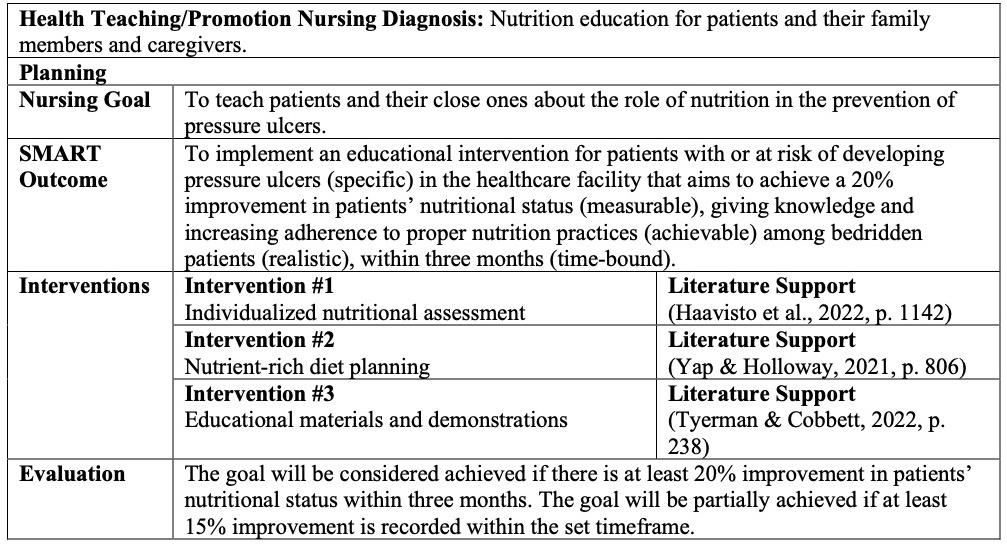
Evidence-based approaches to pressure injury prevention include the use of supporting surfaces, risk assessment, and repositioning (Haavisto et al., 2022). Another evidence-based practice used in research is nutritional supplementation to prevent pressure ulcers (Haavisto et al., 2022; Yap & Holloway, 2021). The effect is reported as moderate, yet it is still worth considering in the future.
The benefits of applying new procedures and evidence-based practices for the medical-surgical client cannot be overestimated. Firstly, patients’ physical and psychological well-being will be enhanced by preventing or accelerating the resolution of pressure ulcers (Al Mutair et al., 2020). Secondly, their hospital stay will be shorter, resulting in a faster recovery. Next, the economic burden on patients will be decreased (Yang et al., 2020). Overall, the patients’ quality of life and comfort will be improved.
Health Teaching Information that Promotes the Health of the Medical-Surgical Client
Useful information for healthcare practitioners on the health promotion of pressure injury patients comes from several sources. First of all, healthcare specialists should be educated about adopting and evaluating skin care protocols (Duggleby & Astle, 2018). Next, they should be informed about the ways of using nutritional supplements for pressure ulcer prevention (Yap & Holloway, 2021). Further, they need to be presented with data on debridement approaches (Al-Jalodi et al., 2021). This information will help nurses foster the health of immobile patients.
Conclusion
Pressure ulcers are not a new problem in health care, but they can benefit from innovative approaches alongside traditional ones to enhance patient outcomes. Due to increased awareness of pressure injury prevention, it is possible to alleviate the problem and achieve better outcomes (Shi et al., 2021; Yap & Holloway, 2021). Interventions utilizing novel approaches and evidence-based practice should be used to decrease the incidence and severity of pressure ulcers.
References
Al Mutair, A., Ambani, Z., Al Obaidan, F., Al Salman, K., Alhassan, H., & Al Mutairi, A. (2020). The effectiveness of pressure ulcer prevention programme: A comparative study. International Wound Journal, 17(1), 214-219.
Alderden, J. G., Shibily. F., & Cowan, L. (2020). Best practice in pressure injury prevention among critical care patients. Critical Care Nursing Clinics of North America, 32(4), 489-500.
Al-Jalodi, O., Serena, L. M., Breisinger, K., Patel, K., Harrell, K., & Serena, T. E. (2021). A novel debridement device for the treatment of hard-to-heal wounds: A prospective trial. Journal of Wound Care, 30(Sup5), S32-S36.
Avsar, P., Moore, Z., & Patton, D. (2021). Dressings for preventing pressure ulcers: How do they work? Journal of Wound Care, 30(1), 33-39.
Duggleby, W., & Astle, B. J. (2018). Evidence-informed practice. In B. J. Astle & W. Duggleby (Eds.), Canadian fundamentals of nursing (6th ed., pp. 75-86). Elsevier Canada.
Haavisto, E., Stolt, M., Puukka, P., Korhonen, T., & Kielo-Viljamaa, E. (2022). Consistent practices in pressure ulcer prevention based on international care guidelines: A cross-sectional study. International Wound Journal, 19(5), 1141-1157.
Health-conditions for all your healthcare needs. (n.d.).
Shi, C., Dumville, J. C., Cullum, N., Rhodes, S., McInnes, E., Goh, E. L., & Norman, G. (2021). Beds, overlays and mattresses for preventing and treating pressure ulcers: An overview of Cochrane Reviews and network meta‐analysis. Cochrane Database of Systematic Reviews, 8.
Tyerman, J., & Cobbett, S. L. (2022). Lewis’s medical-surgical nursing in Canada: Assessment and management of clinical problems (5th ed.). Elsevier Canada.
Yang, K.-L., Chen, L., Kang, Y.-Y., Xing, L.-N., Li, H.-L., Cheng, P., & Song, Z.-H. (2020). Identification of risk factors of developing pressure injuries among immobile patient, and a risk prediction model establishment: A protocol for systematic review. Medicine (Baltimore), 99(52).
Yap, J., & Holloway, S. (2021). Evidence-based review of the effects of nutritional supplementation for pressure ulcer prevention. International Wound Journal, 18(6), 805-821.
Appendix
Table 1 – Care Plan 1
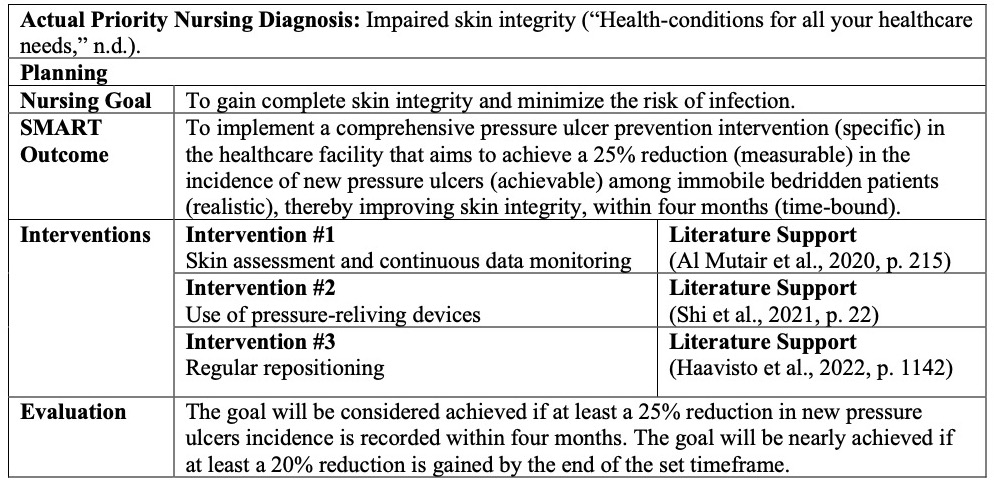
Table 2 – Care Plan 2