
Introduction
One should be aware that COVID-19 was a major health crisis of this century, revealing how vulnerable global society is to supply chain disruptions, economic instability, pandemics, healthcare overload, and misinformation. However, it also showed that the population, as well as the leaders, are unable to grasp the severity of the problem’s exponential growth properly. The given narrative discussion and analysis will explore how the spread of COVID-19 can be described as an exponential function. The doubling rate is the most appropriate measure of disease spread.
Research
The COVID-19 pandemic affected every nation on Earth, but some were more successful at controlling its spread than others. It was estimated that the US alone incurred $14 trillion in economic losses due to the pandemic (Hlavka & Rose, 2023). In addition, the magnitude of the virus was that it affected more than 700 million people worldwide, among whom more than 7 million died due to COVID-19-related deaths (Worldometer, 2024). However, it was also a real-life experiment for how each nation responded to it.
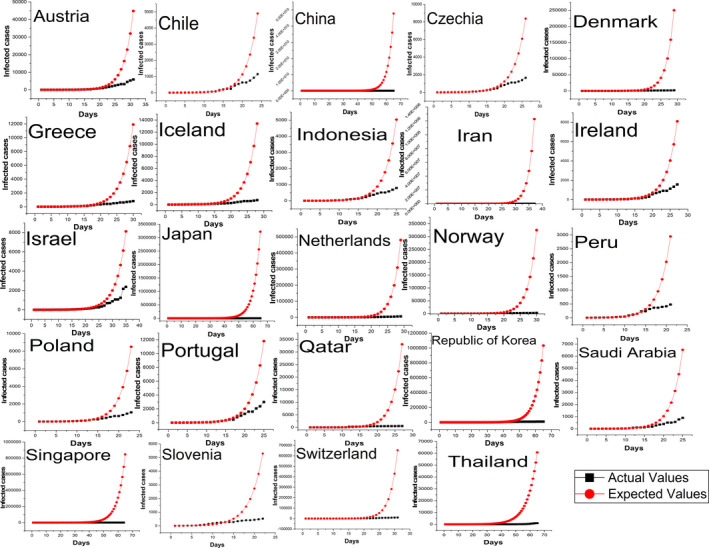
Note. (Kasilingam et al., 2021).
Figures 1 and 2 illustrate how successfully controlling the virus’s exponential doubling rate early, or failing to do so, played out across different countries. Figure 1 illustrates the nations that achieved an appropriate initial level of COVID-19 containment, whereas Figure 2 shows less successful states (Kasilingam et al., 2021). As a result, it showcases how underestimating the exponential doubling rate can quickly get out of control.
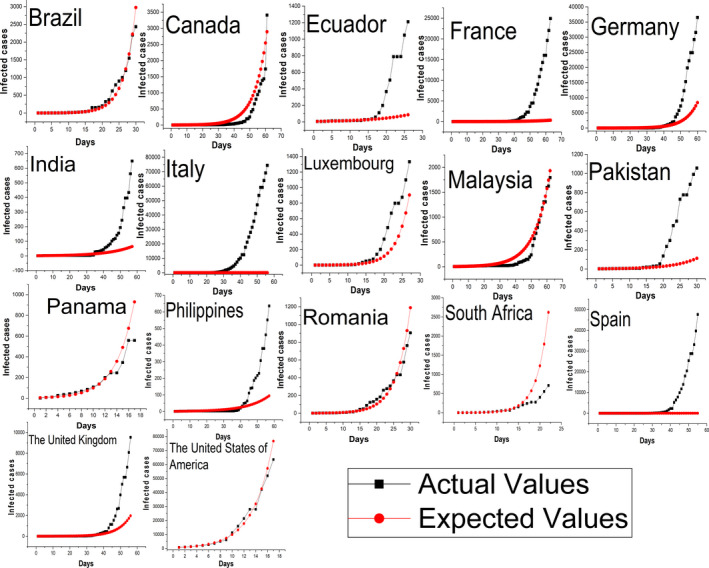
Note. (Kasilingam et al., 2021).
Exponential functions are crucial for understanding how quickly events change, such as the spread of viruses like COVID-19. One can describe an exponential function with the formula:

Here, a stands for the initial amount; however, b is the base that shows the growth or decay rate, and t is the time. In the context of a virus spread, the initial number of cases would be a. Normally, b is greater than 1, indicating that the number of cases grows over time.
A key concept in studying exponential growth in health is “doubling time” (Math Insight, 2024). The latter is the time it takes for a quantity to double, and one can find doubling time using the formula:

The latter comes into play because

when the function

doubles; hence, properly calculating for t from this equation gives the doubling time.
Narrative
When discussing the spread of COVID-19, it is critical to understand exponential growth, which means the number of infected people can rise rapidly over a short period. At the beginning of the pandemic, one infected person could transmit the virus to two others, and each of those two could infect two more. The number of infected individuals would then follow this sequence: 1, 2, 4, 8, 16 – the pattern showcases the fast spread of the virus without control measures (Math Insight, 2024).
In reality, this growth varies due to several factors, including the number of people an infected individual encounters and whether people adhere to health guidelines such as mask-wearing and social distancing. The community’s response speed in implementing health measures also plays a role, as the rapid spread of the virus underscores the importance of understanding its growth (Kasilingam et al., 2021). It helps governments and health organizations make critical decisions, such as when to enforce city lockdowns or how to distribute vaccines effectively.
Health officials could predict the disease’s spread by analyzing initial infection rates and observing how quickly the numbers doubled. Such measures enabled better preparation, allowing one to estimate the need for hospital beds and medical supplies and to provide public safety guidelines (Kasilingam et al., 2021). The importance of exponential growth in the context of COVID-19 extends beyond mere numerical increases.
Each decision by individuals, communities, and governments can massively influence the virus’s spread. For instance, reducing social contacts or widespread vaccine use can sharply decrease infection rates. Knowledge of exponential growth and its implications has provided significant insights into pandemic management.
Conclusion
In sum, the doubling rate explains well how COVID-19 spread exponentially. The best cases are provided by nations that failed to properly implement the necessary containment measures early. Knowing the doubling time is critical, as it helps health officials and governments understand how quickly a disease spreads through a community; this understanding guides the urgency and type of action needed.
A short doubling time means the disease spreads quickly, which is why it requires fast and extensive public health measures to manage the outbreak. Using these mathematical concepts, officials can measure how quickly the disease is growing, which is critical for making informed decisions during a pandemic. Calculating the exponential growth and doubling time of COVID-19 cases has been essential. It helped plan and implement measures such as social distancing, lockdowns, and vaccinations to control and reduce the virus’s spread.
References
Hlavka, J., & Rose, A. (2023). COVID-19’s total cost to the U.S. economy will reach $14 trillion by end of 2023. USC Schaeffer.
Kasilingam, D., Sathiya Prabhakaran, S. P., Rajendran, D. K., Rajagopal, V., Santhosh Kumar, T., & Soundararaj, A. (2021). Exploring the growth of COVID-19 cases using exponential modelling across 42 countries and predicting signs of early containment using machine learning. Transboundary and Emerging Diseases, 68(3), 1001-1018.
Math Insight. (2024). Doubling time and half-life of exponential growth and decay.
Worldometer. (2024). COVID-19 coronavirus pandemic.
