
Background and Rationale
Smoking is an identified risk factor for a range of adverse health outcomes, in particular, the damage it causes to the bones. Scientific research has proven that smoking can harm bone density and cause osteoporosis, which is a condition characterized by brittle bones (6). Several mechanisms have been suggested that supposedly explain how smoking affects bone health.
Research has shown that the toxic effects of smoke from cigarettes directly on the bone cells are one of the possible mechanisms explaining why smoking risks bone health (2). Recent scientific breakthroughs have demonstrated that smoking inhibits bone remodeling, the process by which the original bone structure is maintained for healthy bone health and density (3).
The ossification process accelerated by smoking cigarettes is due to nicotine and other compounds present in cigarettes. Besides, these compounds disrupt the balance of osteoblasts’ bone formation and osteoclasts’ resorption (5). The researchers also point out that in addition to the effect on osteoblast activity, cigarette smoking leads to abnormal bone turnover in the body (1). Hence, a decline in density results in a greater risk of fractures.
Research shows that smoking disrupts the hormonal balance, which is crucial for bone development, and one of the implicated hormones is estrogen, along with vitamin D. Through recent years and scientific discovery, hormones such as estrogen have been extensively researched, and results show that the chemicals lower BMD among smoking women (5). Beyond this, smoking has been subject to scientific analysis, and these scientific studies have shown that the smoking process inhibits the body’s absorption of nutrients such as calcium and vitamin D, which are very important for the development and maintenance of strong and healthy bones (3).
Smoke interferes with the absorption of essential nutrients, leading to brittle bones and the progression of bone loss (5). Also, smoking induces systemic inflammation, oxidative stress, and increased release of some free radicals, thereby reducing bone density and quality (3). According to scientific research, there is a positive correlation between the cessation of smoking and beneficial health outcomes for smokers’ health, which reduces the likelihood of contracting osteoporosis (3).
In the laboratory, bone biochemical parameters and bone mineral density are critical for diagnosing osteoporosis and estimating fracture risk. Older adults worldwide frequently develop osteoporosis with advancing age (5). The diagnosis and treatment of osteoporosis can only be successfully made if quality and reliable diagnostic techniques are used for early detection, intervention, and management of the disorder to reduce its catastrophic morbidity and mortality rates. Diagnosis of osteoporosis is based on biochemical markers that reflect the bone turnover rate, such as collagen metabolism, and on imaging modalities, such as DXA, that assess bone density (5). Laboratory tests in the clinic provide data on bone health status, enabling assessment of fracture risk and the application of appropriate therapy.
Despite the clear connection between smoking and reduced bone health, as evidenced by changes in bone biochemistry parameters and bone mineral density, there remains a gap in research specifically examining how smoking affects the outcomes of these critical diagnostic tests. Bridging this gap is essential for enhancing our understanding of the full impact of smoking on bone health and for developing targeted interventions to mitigate this risk, particularly among populations at heightened risk of osteoporosis.
Research Question(s) and Objectives
Research Questions
- How does smoking status affect bone mineral density measurements at different bone sites?
- What is the relationship between biochemical laboratory test results and bone mineral density measurements among smokers, non-smokers, and past smokers?
- Are there significant differences in biochemical laboratory test results among smokers, non-smokers, and past smokers?
- What can be the application of the data obtained from this study in laboratory management?
Aim
This study aims to investigate the influence of smoking on the association between biochemical laboratory tests and bone mineral density measurements at different bone sites.
Objectives
- To determine and assess the biochemical markers that are influenced by smoking and learn how these variations influence BMD measurements.
- To compare bone mineral density measurements between smokers, non-smokers, and past smokers at three different bone sites
- To provide evidence-based recommendations for laboratory managers and healthcare professionals regarding the interpretation of bone health assessments, especially when a patient’s smoking history is considered.
Materials and Methods
Ethical Approvals
All samples are obtained from Qatar Bio-Bank (QBB). Written informed consent has been secured from all participants involved in this study. Ethical approval has been obtained from the QBB IRB.
Qatar Biobank Cohort
The Qatar Biobank Cohort study is a comprehensive research endeavor. Through pinpoint accuracy in recruitment and data collection, Qatar Biobank can guarantee the quality and applicability of data. This facet encompasses rigorous data collection and sample preservation.
Variables for QBB Participants
The study cohort included samples of healthy participants from QBB data. Subjects with chronic diseases that might affect the BMD value were excluded to minimize the effect of environmental and therapeutic factors on BMD measurements. The biomarkers, such as calcium, phosphorus, 25-hydroxyvitamin D, and alkaline phosphatase, will serve as independent variables, and BMD at different bone sites will be assessed separately as binary outcomes (normal or low). Smoking status will be assessed as an independent variable in some analyses and a moderator in others.
Statistical Analysis
Data collected for this research will be analyzed statistically using SPSS (Statistical Package for the Social Sciences). Two tests will be performed for this study: logistic regression and odds ratio tests. Logistic regression analysis will be used to examine the relationship between smoking status (i.e., current smoker, non-smoker, or past smoker) and bone mineral density measurements at the specified bone sites. This analysis will help to determine the effects of smoking on BMD values while accounting for smoking status as a confounder by stratifying the analysis for each layer of smoking status groups. Additionally, the logistic regression model will be constructed with BMD measurements as the dependent variable and smoking status as the primary independent variable in some analyses. Notably, other relevant covariates such as gender, age, and biochemical markers will be included in the model to adjust for potential confounding effects.
Further, this analysis will provide odds ratios and corresponding confidence intervals, which will help quantify the association between smoking status and BMD measurements. The corresponding information gained from this analysis will be useful in assessing the risk of low BMD and osteoporosis in patients with markedly different smoking histories. The odds ratio, as a statistical measure, will be used in this project to quantify the association between an exposure (smoking status) and an outcome (low or normal BMD). According to Gosho et al. (2023), this measure represents the odds of an outcome in the exposed group compared with the odds of a similar outcome in the non-exposed group (7).
The odds ratio from logistic regression will indicate the relationship between a participant’s smoking status and their BMD measurement. The combination of these two statistical measures will enable a comprehensive understanding of the relationship between smoking status, biochemical laboratory tests, and bone mineral density measurements. As such, the insights from this analysis will contribute to the laboratory management practice knowledge base and will further entrench evidence-based healthcare.
Techniques Mastered Through the Project
- Data Analysis
- Statistical analysis using software packages such as SPSS.
- Report writing and presentation skills.
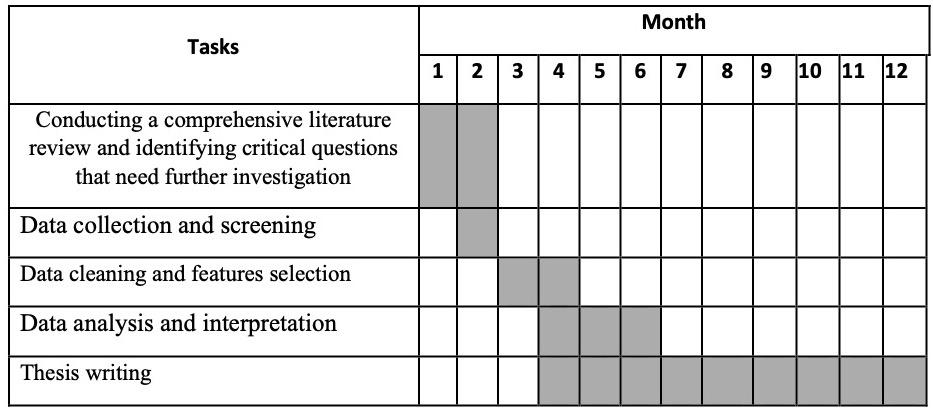
Work Timeline
Table 1 – Timeline
Context
This research project is closely intertwined with the central themes of the laboratory management track, as it requires improving research efficiency within lab environments. The study explores the impact of smoking on the outcomes of biochemical laboratory tests related to bone mineral density. Research shows that an osteoporosis diagnosis can be made through routine laboratory testing in a primary care setting (4). Therefore, this research is an invaluable source of information for laboratory managers and healthcare providers. Scientific findings from this study provide a platform for organizations to offer quality diagnostic services available through labs.
This study highlights the importance of internal factors, such as lifestyle behaviors, in the accurate and complete presentation of laboratory test results. Subsequently, this contributes to advancing scientific knowledge in laboratory management. By showing the connection between smoking and laboratory test results, people can make informed decisions. It enhances the quality of patient care within the laboratory.
Studies suggest that bone turnover markers are essential for clinical decision-making (1). Drawing on this, the investigation provides a basis for informed decision-making in the laboratory. This aspect improves the quality of care provided within the laboratory context, consequently meeting the core objectives of the laboratory employment track.
References
- Al-Bashaireh, A. M., & Alqudah, O. (2020). Comparison of bone turnover markers between young adult male smokers and non-smokers. Cureus, 12(1).
- Ghadimi, R., Hosseini, S. R., Asefi, S., Bijani, A., Heidari, B., & Babaei, M. (2018). Influence of smoking on bone mineral density in elderly men. International Journal of Preventive Medicine, 9(1), 111.
- Kiyota, Y., Muramatsu, H., Sato, Y., Kobayashi, T., Miyamoto, K., Iwamoto, T., Matsumoto, M., Nakamura, M., Tateno, H., Sato, K., & Miyamoto, T. (2020). Smoking cessation increases levels of osteocalcin and uncarboxylated osteocalcin in human sera. Scientific Reports, 10(1).
- Merlijn, T., Swart, K. M., Niemeijer, C., van der Horst, H. E., Netelenbos, C. J., & Elders, P. J. (2024). The yield of routine laboratory examination in osteoporosis evaluation in primary care. Osteoporosis International, 1-8.
- Trevisan, C., Alessi, A., Girotti, G., Zanforlini, B. M., Bertocco, A., Mazzochin, M., Zoccarato, F., Piovesan, F., Dianin, M., Giannini, S., Manzato, E., & Sergi, G. (2020). The impact of smoking on bone metabolism, bone mineral density and vertebral fractures in postmenopausal women. Journal of Clinical Densitometry, 23(3), 381-389.
- Valeh, T., Gharibzadeh, S., Tajrishi, F. Z., Fahimfar, N., Meibodi, H. R. A., Shafiee, G., Heshmat, R., Ostovar, A., Sanjari, M., Nabipour, I., & Larijani, B. (2020). The association of tobacco smoking and bone health in the elderly population of Iran: Results from Bushehr elderly health (BEH) program. Journal of Diabetes & Metabolic Disorders, 19, 461-468.
- Gosho, M., Ohigashi, T., Nagashima, K., Ito, Y., & Maruo, K. (2023). Bias in odds ratios from logistic regression methods with sparse data sets. Journal of Epidemiology, 33(6), 265–275.
