Executive Summary
Using statistical analysis techniques to inform decision-making, regardless of the application, makes tremendous practical sense. Rather than choosing between options based solely on personal experience, opinions, and preconceived judgments, data analysis provides valuable results that are virtually free of error, human error, and subjectivity. For this reason, in fields where human lives depend on outcomes, including the clinical industry, the use of statistics to make informed and sound decisions is vital. This paper describes the results of a cohort study that sought to determine whether music therapy reduces pain perception and improves postoperative recovery outcomes.
Problem Background
One of the key challenges in today’s clinical industry is continually improving the patient experience of care and interactions with medical staff. A review of academic sources reveals that a large proportion of the literature focuses on the author’s desire to identify strategies and techniques to improve patient experience (Liang et al., 2021; Giordano et al., 2020; Lam et al., 2020). One such evidence-based direction is music therapy.
In simple terms, music therapy involves the patient listening to music, which should reduce pain and provide emotional relief. However, there are significant contradictions regarding music therapy. On the one hand, some authors report benefits of this approach: among the cited benefits are improved experience of stressful events and improved biological performance (Liang et al., 2021; Lam et al., 2020; Giordano et al., 2020).
On the other hand, authors frequently report no benefit from music therapy (Mukherjee & Mutnury, 2021). Such contradictions lead to the conclusion that, to date, academic discourse lacks an understanding of the effects of music therapy on patients’ experiences. Furthermore, it cannot be ruled out that the relationship between variables is more complex than it appears at first glance. This underscores the need for research to prove or disprove the effectiveness of music therapy.
Research Goal, Objectives, and Questions
The purpose of the present study was to determine the effect (or lack thereof) of music therapy on the clinical outcomes of surgical intervention in patients. The outcomes used in this study were patient physiologic measures (heart rate, systolic blood pressure) and psychocognitive measures, namely perceived anxiety. This research objective is quite general and complex in execution, so to successfully achieve it, it was necessary to solve three consecutive tasks, namely:
- ▪ To conduct statistical analysis of the collected data based on the selected tests and techniques;
- ▪ To conclude what effect, if any, music therapy has on the selected characteristics.
The vector for this study was established through the use of questions to guide the flow and to set the stage for selecting appropriate statistical methods. Specifically, three research questions framed the entire work, namely:
- Do patients listening to classical, preferred, or no music find a difference in their mean anxiety scores?
- Is there a difference in pre- and post-procedure heart rate for patients who received music therapy?
- Is there a relationship between the patient’s systolic blood pressure and level of perceived anxiety before surgical intervention?
Methods
The present research project used an experimental design: the total sample was divided into groups according to the chosen intervention method, and results were compared across groups. The project sample comprised 60 participants, randomly distributed into three groups of 20 each. Participants in the first group were offered classical music to listen to, participants in the second group listened to music of their choice (preferred), and patients in the third (control) group did not listen to any music. The interventions were performed before, during, and after surgery, allowing for retrospective comparison of data and assessment of dynamic effects. Thus, the present study can be defined as an experimental quantitative design using both cross-sectional and longitudinal logic techniques.
Many variables assessing both psychocognitive and physiological measures of patients in different groups were used. However, for this project, only a few were of particular interest. First, anxiety level was used as the dependent variable, measured on a continuous scale from 0 to 10 (10 = maximum anxiety); in other words, this variable was self-reported.
Second, heart rate was used as another dependent variable, measured as the number of heartbeats per minute over one minute. Third, systolic blood pressure, a continuous measure, was used as the dependent variable. The type of music intervention was used as the independent variable, measured at three levels: classical, preferred, and control.
Data Collection
The data were pre-collected into a single dataset and used for statistical analysis in JAMOVI. To answer the first research question, One-Way ANOVA was used because the dependent variable was continuous, and the independent variable represented the three categorical groups. To answer the second research question, a paired-samples t-test was used to evaluate differences in mean heart rate before and after surgery for all patients.
As an appropriate method for the third research question, a correlation test was used to determine the nature of the relationships between variables, namely their direction and strength. It is imperative to emphasize that the results of a correlation analysis cannot be used to infer causal relationships, since this type of test only describes the characteristics of the relationship between two continuous variables. In addition, because performing correlation analysis requires checking assumptions, the distributions of systolic blood pressure and perceived anxiety levels in patients were checked for normality, absence of severe outliers, and linearity of the relationship before running the corresponding test.
Data Analysis
The overall analytical approach consisted of several steps. First, the entire collected data set was examined, and variables were reviewed and defined. Second, all redundant and unnecessary variables within the scope of this study were removed from the array to avoid potential errors and data loading issues. Third, based on the structure of the research questions, relevant hypotheses were formulated and tested through calculated p-values. In general, if the calculated p-value for a test was above the chosen significance level, this indicated that the null hypothesis could not be rejected and, thus, that there was no effect being tested. All results were obtained through automatic calculations in JAMOVI and are attached in the Appendices to this essay.
Results
Results of One-Way ANOVA
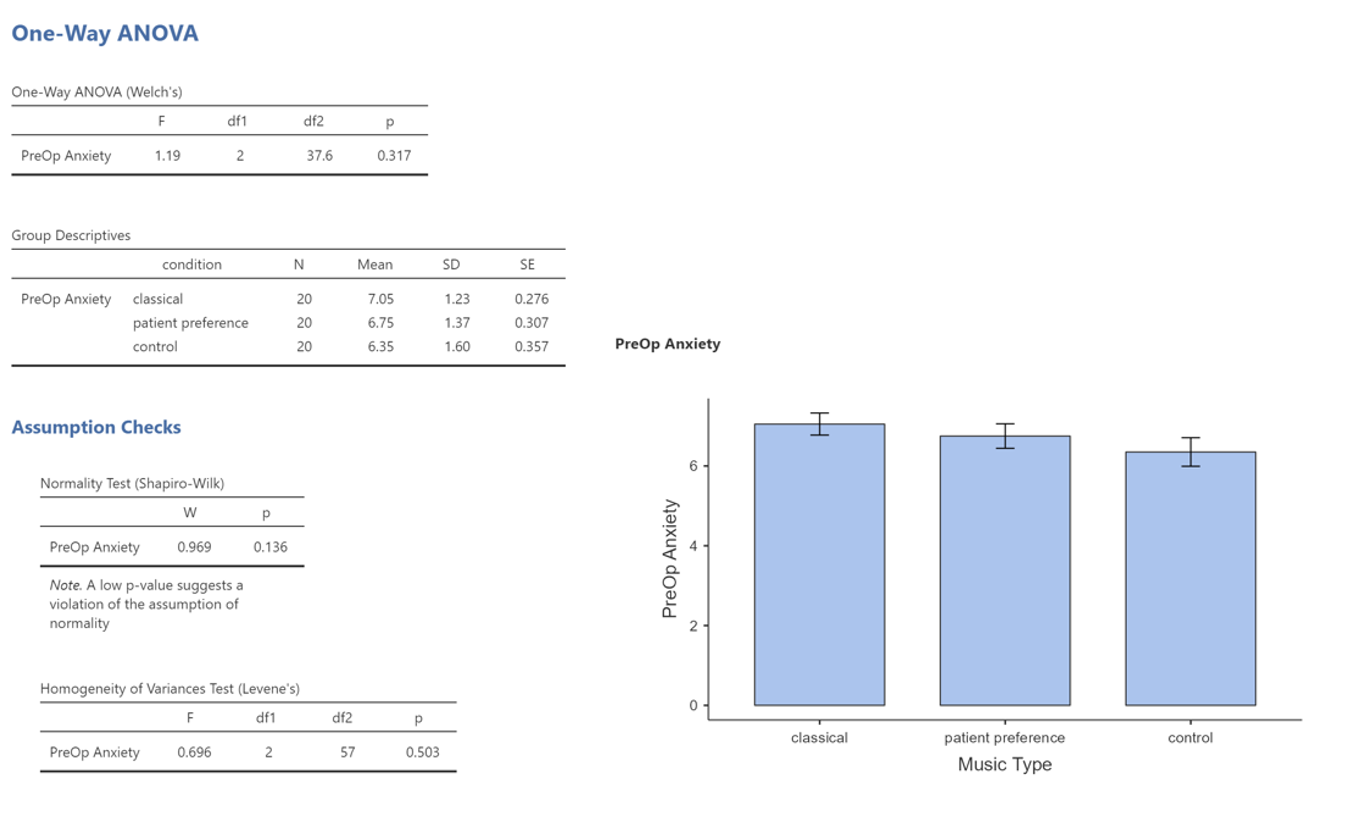
An ANOVA was used to test differences in patients’ perceived anxiety means across the three intervention groups. Results showed no statistically significant differences between groups (F(2, 37.6) = 1.19, p =.317). Specifically, a p-value above the significance level indicated that the null hypothesis postulating no differences between groups could not be rejected.
Since no significant differences between groups were found in the ANOVA, a post hoc test was not appropriate. Overall, anxiety in the classical music group (M = 7.05, SD = 1.23) did not differ from that in the preferred music group (M = 6.75, SD = 1.37) or the control music group (M = 6.35, SD = 1.60). A detailed summary of the ANOVA results obtained using JAMOVI is available in Appendix A.
Results of Paired Samples t-Test
The essence of this analysis was to test differences in the mean values of the target variable between two related samples. In simple terms, this test compares the variable’s values before and after the intervention. In this section, the intervention is defined as surgery on the patient, and no separation into musical groups was performed.
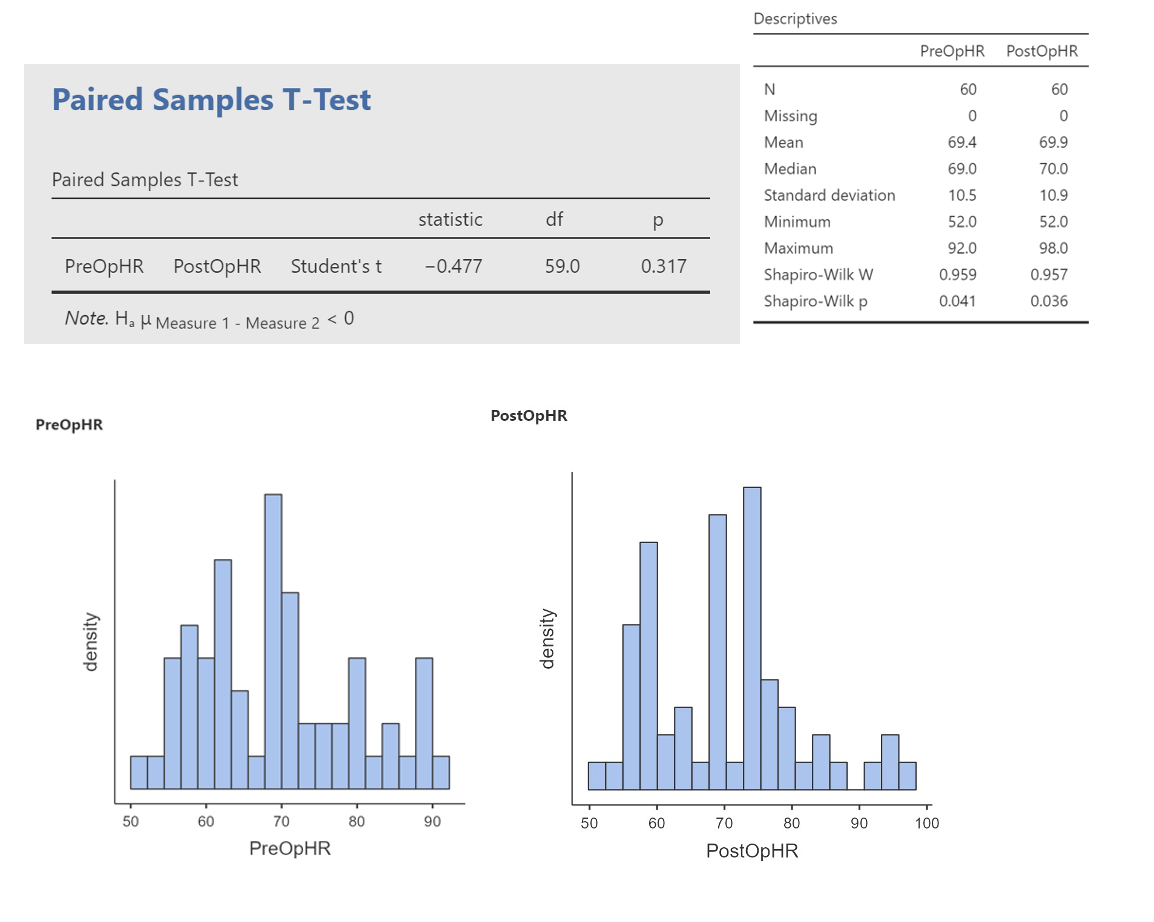
The test results showed no significant difference between the pre- and post-intervention scores (t(59) = -0.477, p =.317). A p-value exceeding the significance threshold (α =.05) indicated that the null hypothesis, which assumes no difference between the pre- and post-intervention groups, could not be rejected. It followed that the patients’ preoperative (M = 69.4, SD = 10.5) and postoperative (M = 69.9, SD = 10.9) heart rates did not differ statistically significantly. In other words, the results show that the experience of surgery has little effect on patients’ heart rate. A detailed summary of the t-test results obtained with JAMOVI is available in Appendix B.
Pearson Correlation Results
Pearson’s correlation analysis is used to test the direction and strength of the association between two variables; the outcome is a number between -1.00 and +1.00 (including both ends), where +1.00 corresponds to the strongest positive association. To perform a Pearson correlation analysis, both variables must fulfill several requirements. In addition to being continuous, they must also be approximately normally distributed.
Results of Shapiro-Wilk Tests
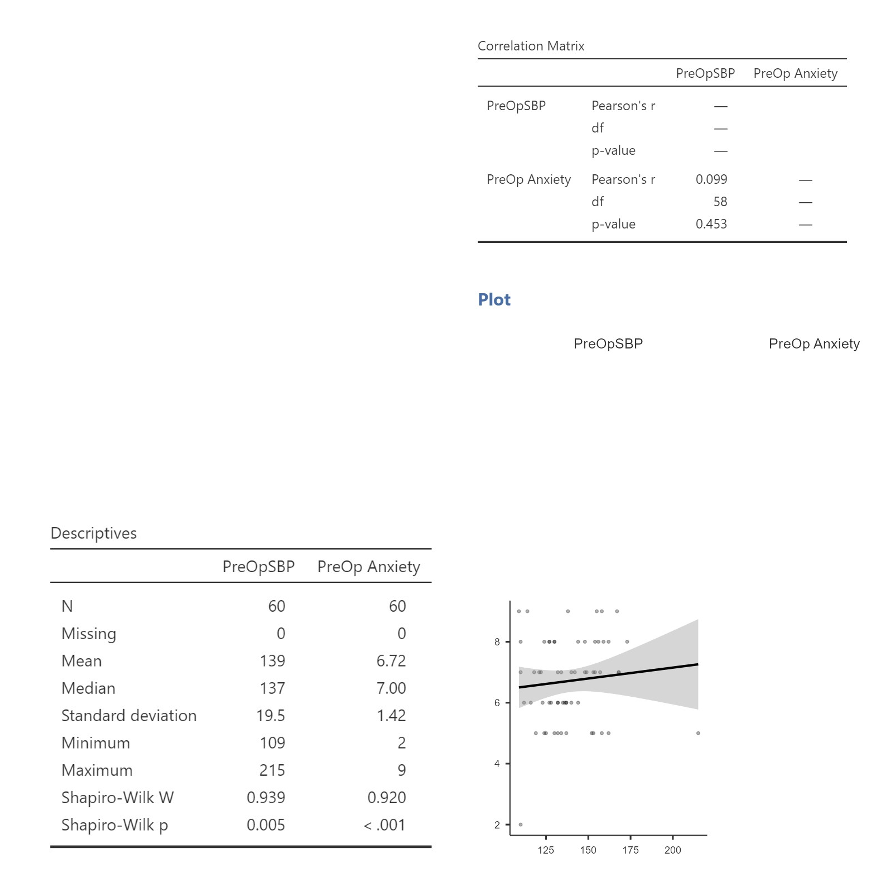
Results of Shapiro-Wilk tests showed that neither systolic blood pressure (p =.005) nor anxiety level (p <.001) was normally distributed; however, the correlation analysis is relatively robust to violations of this assumption. There should also be a linear relationship between the variables, which, however, was not confirmed by visualization in the scatter plot (Appendix C). The analysis, as expected, showed no relationship between the variables (r =.099, p =.453). This implies that there is no pattern of change in systolic blood pressure levels when anxiety levels increase, and vice versa. A detailed summary of the correlation analysis results obtained using JAMOVI is available in Appendix C.
Discussion
The present study aimed to investigate the effects of music therapy on physiologic and psychocognitive parameters in patients before and after surgical intervention. The work had related objectives, namely, not only to determine the effects of music therapy but also to identify the effects of individual genres on target variables. The results, however, showed no significant effects. First, there were no differences in mean anxiety levels between the three music intervention groups (classical, preferred, and control).
Second, pre- and post-intervention heart rates did not differ significantly, indicating that music therapy did not affect this measure. Third, correlation analysis showed that there was no relationship between anxiety level and systolic blood pressure, which means that these psychocognitive and physiological indicators are not related. In other words, the results of the present study support the findings of Mukherjee and Mutnury (2021), indicating the ambiguity of music therapy outcomes, and contradict those of Liang et al. (2021), Giordano et al. (2020), and Lam et al. (2020) entirely. This only confirms the uncertainty of the results regarding music therapy, or, to put it another way, potentially points to additional factors mediating its effects that are not addressed in this paper.
It is appropriate to discuss the implications of the findings for nursing practice. Because music therapy has not shown effects on improving patient experience, its use may not seem like a worthwhile investment or a waste of time. Instead, nurses are encouraged to focus on other methods that may be more effective in meeting performance targets.
There are also implications for academic clinicians: the results indicate the need for additional, deeper studies to identify the factors that may mediate the relationship. For my clinical practice, the results indicate that the use of music therapy is unwarranted. Because I encourage evidence-based conclusions, this strategy seems ineffective and inappropriate.
Limitations
The present study has several limitations that may have affected the quality of the results obtained. First, the sample sizes in each of the three groups were relatively small (≤30), which could lead to bias in the results and the occurrence of systematic error. Second, the assumptions for ANOVA and t-tests were not tested, and the normality and linearity assumptions for the correlation analysis were violated. In this case, it would have been more appropriate to use non-parametric alternatives that yielded more accurate results for the available data. Third, the preferred music category used for the analysis was not standardized: this means that some patients in the preferred music group may have chosen classical music, creating overlap between groups. Fourth, anxiety as a variable was measured on a self-report basis, which means that Hawthorne effects and reduced honesty of the results cannot be ruled out.
Addressing the limitations described above may be a future extension of the present project; there are also additional directions for future work. First, it is proposed to implement a larger number of standardized musical choices to eliminate potential group overlap and create homogeneous cohorts. Second, it is proposed to assess additional psychocognitive measures, including a standardized patient satisfaction questionnaire. Third, it is appropriate to establish controls in the measurement room, as external factors (air temperature, noise level, light intensity, and color) may affect patients’ mood and, consequently, the state of psychocognitive and physiological indicators. Fourth, the introduction of demographic variables (age, gender, ethnicity) is also suggested as an area for further research to test cohort analyses of the target variables and determine whether there are demographic differences in outcomes.
References
Giordano, F., Scarlata, E., Baroni, M., Gentile, E., Puntillo, F., Brienza, N., & Gesualdo, L. (2020). Receptive music therapy to reduce stress and improve wellbeing in Italian clinical staff involved in COVID-19 pandemic: A preliminary study. The Arts in Psychotherapy, 70, 1-5.
Lam, H. L., Li, W. T. V., Laher, I., & Wong, R. Y. (2020). Effects of music therapy on patients with dementia — A systematic review. Geriatrics, 5(4), 1-14.
Liang, J., Tian, X., & Yang, W. (2021). Application of music therapy in general surgical treatment. BioMed Research International, 1-4.
Mukherjee, O., & Mutnury, S. L. (2021). Management of chronic illness through music therapy: A review. Indian Journal of Health Studies, 3, 55-94.
Appendix A — One-Way ANOVA Results
Appendix B — Paired Samples t-Test Results
Appendix C — Pearson Correlation Results