
Physiological Differences Measurements
Aron, the 23-year-old who regularly plays soccer, can maintain a steady pace. Therefore, it is possible to maintain the same tempo throughout a measured exercise. A lab-based test on intense activity like treadmill test is the appropriate way to measure VO2max for Aron. A moderately fit individual can sustain a VO2max speed of approximately 6 to 8 minutes. Therefore, Aron can run on a treadmill at maximum intensity for 8 minutes while wearing breathing equipment that measures the amount of oxygen inhaled and carbon dioxide (CO2) released. It directly quantifies the oxygen consumption and conversion to CO2.
Roger, on the other hand, is a 56-year-old office worker who rarely exercises. Walking for approximately 5 to 9 kilometers a day, resistance training, and occasional short High-intensity interval training (HIIT) for 20 seconds at 100% effort and 60 seconds in an outside environment will be appropriate for testing. Roger’s VO2max should be measured with fitness trackers like the Garmin Forerunner 230 and the Polar V800. The trackers measure heart rate, distance covered, and time spent running or exercising, and they produce estimates based on the data inputs.
For instance, data such as age, weight, sex, and maximum heart rate are entered by the trainer. However, research shows that capturing physiological parameters using these trackers yields marginal accuracy; therefore, the trainer can adjust the error margin (Passler et al., 2019). The approach is also convenient for his advanced age, since he can adapt the exercise to routine activities, which accurately reflect the environment he works in and his lack of fitness.
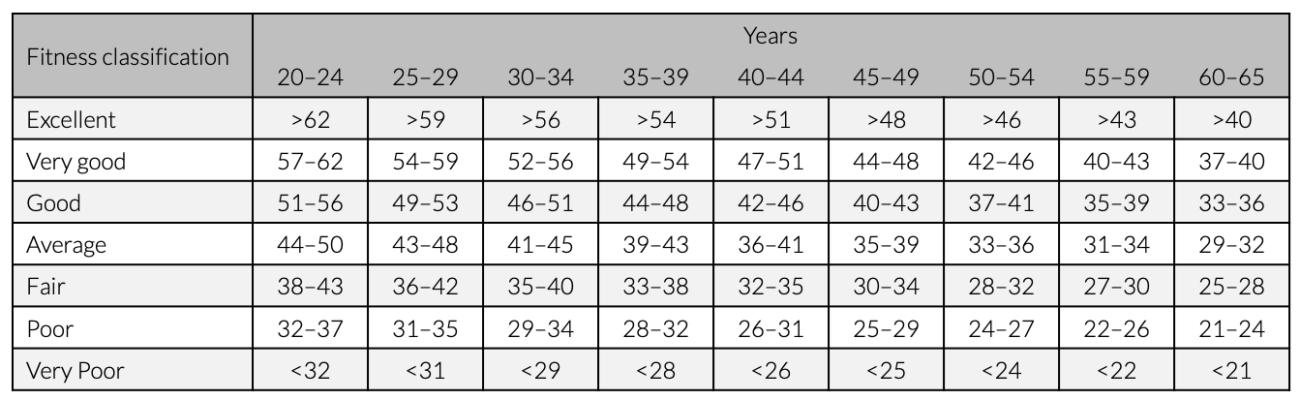
The calculation of VO2max is based on results from equipment such as trackers and Fitmate Med that measure maximal oxygen uptake in the lab. The range of VO2max results can be compared with the age- and gender-specific chart below (Figure 1).
Physiological Adaptation to Exercise
The heart of an athlete can differ from that of a less physically active person. Chronic, or long-term, physiological adaptation due to training occurs over an extended period of physical activity. The heart muscle in Aron has undergone hypertrophy, an increase in the size of the sarcomeres within the muscle fiber, to adapt to the routine workout.
Therefore, greater pressure can be generated with every single heartbeat, increasing blood flow to the body compared to a sedentary individual like Roger. The long-term effect of intense physiological activity is an increase in both resting and exercising stroke volume (SV) (Bernardi et al., 2020). An SV is the amount of blood pumped from the left ventricles in one contraction to the working tissues and muscles of the body. The SV for a person lacking training or fitness will be lower; hence, Roger will experience windedness after walking up the stairs.
Another physiological difference between Aaron’s and Roger’s influence on cardiovascular capacity is the shorter recovery time for breathing rate. Heart rate recovery time is the time it takes for the heart rate to return to its resting rate after exercise. A fit person would be expected to have a shorter time to return to normal heart rate than an unfit person. The longer it takes, even for a slight activity like walking up the stairs, the stronger the indication of unfitness or potential illness.
References
Bernardi, M., Guerra, E., Rodio, A., Dante, D., Castellano, V., Peluso, I., Schena, F., & Bhambhani, Y. (2020). Assessment of exercise stroke volume and its prediction from oxygen pulse in Paralympic athletes with locomotor impairments: Cardiac long-term adaptations are possible. Frontiers in Physiology, 10, 1–12.
Passler, S., Bohrer, J., Blöchinger, L., & Senner, V. (2019). Validity of wrist-worn activity trackers for estimating VO2max and energy expenditure. International Journal of Environmental Research and Public Health, 16(17), 1–13.
