
Introduction
Depression is a critical type of mental disorder and is presently a prominent public health concern worldwide. The condition affects almost all age groups, though some clusters show increased risk. For instance, Handing et al. (2022) argue that women are more likely to experience depressive disorders compared to men.
The scholars provide elevated hormonal fluctuations at different times in life, including puberty, pregnancy, postpartum phases, and perimenopause and postmenopausal stages, as some of the most critical episodes when females suffer increased depression levels. Similarly, Choi and Lee (2022) say that women show increased depression risks within the middle-aged bracket between 40 and 60 years. This aspect implies notable underlying factors that cause the condition and other related health and social issues.
Rationale for the Study
The desire to generate reliable, harmonized reports regarding evidence-based findings on the risk factors connected with depression in middle-aged women informs the present mini-systematic review. The work investigates previous studies on the subject to deduce a final account that can inform policy and practice transformation. An examination of existing scientific investigations reveals at least two critical issues. The first problem concerns the open disagreements among scholars’ findings on what causes depression among middle-aged women. The second major concern regarding the topic is the striking absence of adequate scientific work covering the subject.
Research Questions
Defining the research question forms the first phase of conducting a systematic review. The research question in the present case is: what are the specific risk factors and occurrence rate of depression in middle-aged ladies? Clearly defining the research question helps focus the search efforts and guarantees the evaluation of relevant studies. As noted earlier, the subject under investigation is poorly studied, while the available evidence on the causative factors is contradictory. Accordingly, the question defines risk factors as the primary item being investigated across the different sources.
Research Aims/Objectives
The primary aim of this work is to provide reliable, evidence-based data to help unravel a major issue in the healthcare sector. Depression among middle-aged females is a pressing issue characterized by persistent feelings of sadness, lack of interest, and hopelessness. The disorder often profoundly affects people’s social interactions, overall well-being, and quality of life. The present work aims to deliver evidence-based information on scientific findings to help avert the syndrome’s occurrence in the critical population. The following are the specific objectives of the current work:
- Screening available research findings to classify studies worth inclusion in investigations examining risk factors for depression among middle-aged women.
- Extracting data from various studies, including information on study design, risk factors for depression, sample characteristics, and prevalence rates, to provide an inclusive summary of the existing evidence on depression in middle-aged females.
- To synthesize evidence from various research works to identify collective risk factors for hopelessness in middle-aged ladies and define the frequency rates of disorders in the population.
Methods
Eligibility
All incorporated articles met specific inclusion criteria to support the targeted results. The criteria included focusing on depression in middle-aged women, inclusion of the study population aged between 40 and 60 years, and the assessment of risk factors related to depression in middle-aged females. Accordingly, the absence of an intervention aspect in the study selection process led to the use of a PEO framework that focuses on population, exposure, and outcomes. The population comprises middle-aged females aged 40-60 years; the exposure or issue is depression; and the risk factors constitute the outcomes under examination. All studies meeting these parameters were included in the research, while the rest were excluded, even when they contained some of the required elements.
Search Strategy
A comprehensive search was conducted to ensure this mini-systematic review succeeded. The search used Google Scholar, PubMed, and PsycINFO databases. Keywords or search terms adopted for the study included “depression,” “risk factors,” and “middle-aged women.” The search used a blend of Boolean operators and keywords to narrow results to the most relevant studies. The chosen databases primarily contain free-access, reliable, and verifiable content. Most of the incorporated articles are published by professional scholars and are peer-reviewed, demonstrating the reliability of the procedures and outcomes.
Data Analysis
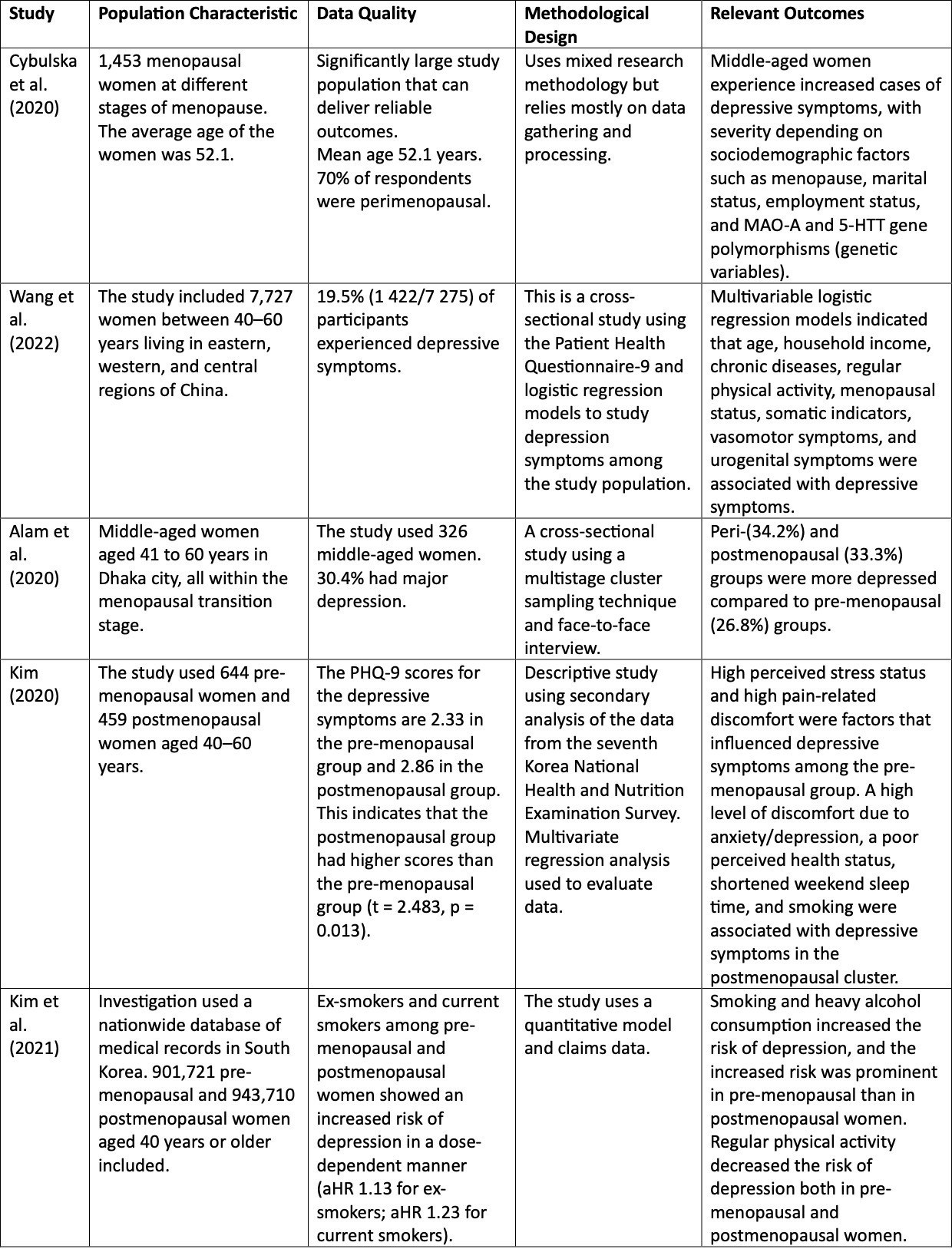
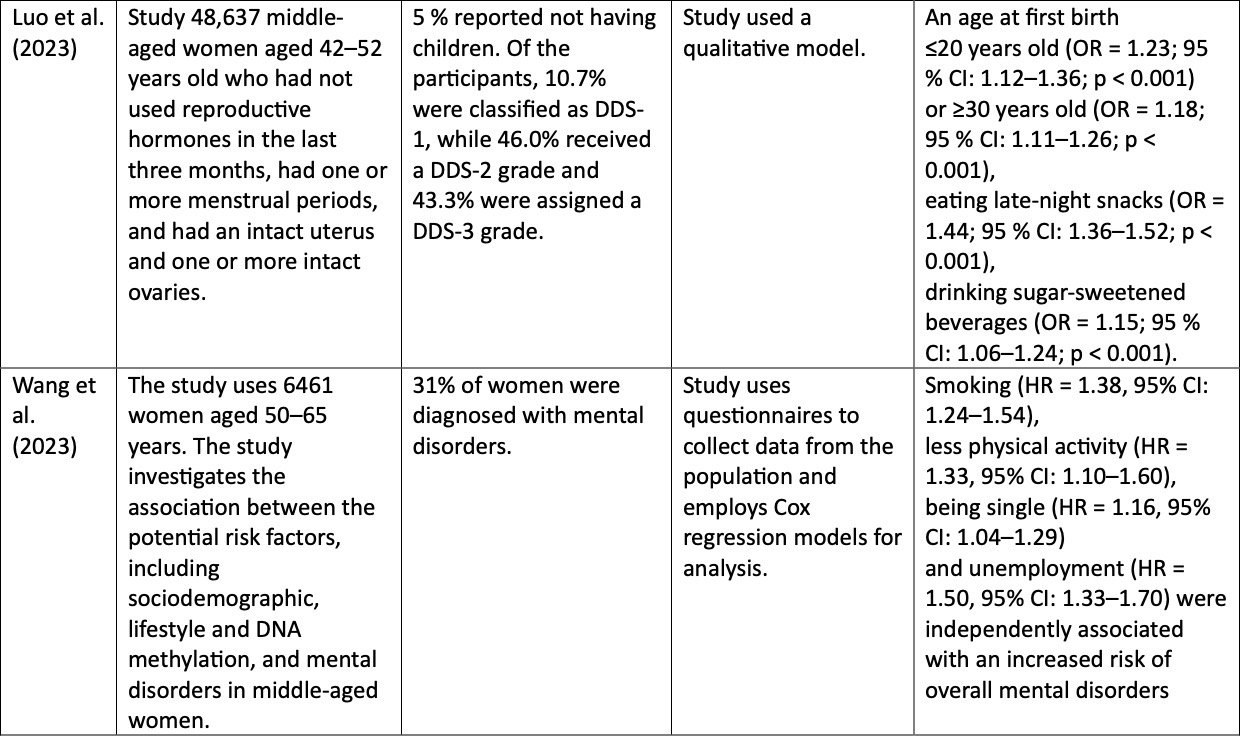
Table 1 – Narrative Synthesis
Results
A total of seven relevant scientific articles met the inclusion criteria. Based on the acquired outcomes, one out of five women in the postmenopausal phase presents depressed states. This aspect is related to giving birth at a younger age, having a past and current obstetrical complication, and substance use.
Additionally, the included articles’ findings show that the prevalence and course of middle-aged women’s depression should receive augmented attention. Furthermore, sociodemographic and socioeconomic factors are strong independent determinants of depression among middle-aged females. Lastly, some studies show that women with specific hormones or genes have an increased risk of suffering depression.
Summary of the Main Findings
Depression is a real health condition among middle-aged women and results from multiple factors. Menopause, socioeconomic status, marriage status, and age are primary parameters affecting this age group’s psychological well-being. Cybulska et al. (2020) say that menopause comes with significant hormonal imbalance and body aches, which gives middle-aged ladies notable stress.
However, failure to perform physical activities, smoking, heavy alcohol consumption, and giving birth very early are remarkable contributors to depression among middle-aged women. Alam et al. (2020) divide the menopausal period into three categories, pre-, peri-, and post-menopausal periods, with the latter two groups experiencing more hormonal imbalance that worsens their depression level relative to the pre-menopausal women. Lastly, being single, unemployed, and obese, on top of being post-menopausal, worsens depression symptoms among the middle-aged ladies.
Interpretation of the Main Findings
Findings from the present critical review confirm that middle-aged women suffer from depression more than other groups. The lot exhibits several factors that expose it to this condition. Examples of such parameters include being peri- or postmenopausal, in which the body stops producing adequate estrogen due to age (Cybulska et al., 2020). The aspect leads to significant body changes, with hormonal imbalance leading to stress and depression. These signs worsen among women with specific genes, single, unemployed, those abusing substances, and the lot failing to undertake physical exercise.
Critical Analysis and Evaluation of Scientific Evidence
All the utilized sources report depression symptoms among middle-aged women, with each providing unique factors that cause the syndrome. The articles are peer-reviewed and utilize reliable methodologies to realize their findings. For instance, Cybulska et al. (2020) employ a mixed-methods research design, while Wang et al. (2022) and Alam et al. (2020) use a cross-sectional design. Kim (2020) further employs a document review approach, and Blümel et al. (2020) is a 27-year cohort study. The sources use verifiable methods, and all agree that being menopausal, leading a poor lifestyle, being unmarried, plus having specific genes contribute markedly to the extreme cases of depression among middle-aged women.
Limitations and Future Considerations
The critical review approach remains a powerful method for gathering relevant information about subjects to make informed conclusions. Using the tactic on the issue of depression among middle-aged women helps in bringing together various factors that lead to the condition. The present work decisively maintains that the condition is a real concern among the population, and that being menopausal and unmarried, leading a poor lifestyle, plus having specific genes worsen depression symptoms among the group. The aspect reveals a major strength of the adopted approach, but it also exposes scholars to the original researchers’ biases if they are present. Thus, a reliable future consideration is the possibility of conducting an empirical study to take charge of the research process and obtain personal findings.
Conclusions
Findings acquired from the evaluated studies show that depression is a major health concern among middle-aged women. Different factors, including age, obstetrical complications, substance use, lifestyle aspects, and socioeconomic status, play a substantial role in the syndrome’s prevalence in this population. Accordingly, policies intended to improve health among the studied population should promote physical activity, obesity prevention, and drug abuse avoidance to avert the syndrome. Governments should also enact policies to help menopausal women live healthy lives by educating them on best practices for maintaining health.
References
Alam, M. M., Ahmed, S., Dipti, R. K., & Hawlader, M. D. H. (2020). The prevalence and associated factors of depression during pre-, peri-, and postmenopausal periods among the middle-aged women of Dhaka city. Asian Journal of Psychiatry, 54.
Blümel, J. E., Carrillo-Larco, R. M., Vallejo, M. S., & Chedraui, P. (2020). Multimorbidity in a cohort of middle-aged women: risk factors and disease clustering. Maturitas, 137, 45-49.
Choi, H. S., & Lee, J. E. (2022). Factors affecting depression in middle-aged and older men living alone: a cross-sectional path analysis model. American Journal of Men’s Health, 16(1).
Cybulska, A. M., Szkup, M., Schneider-Matyka, D., Skonieczna-Żydecka, K., Kaczmarczyk, M., Jurczak, A., Wieder-Huszla, S., Karakiewicz, B., & Grochans, E. (2020). Depressive symptoms among middle-aged women—Understanding the cause. Brain Sciences, 11(1), 26.
Handing, E. P., Strobl, C., Jiao, Y., Feliciano, L., & Aichele, S. (2022). Predictors of depression among middle-aged and older men and women in Europe: a machine learning approach. The Lancet Regional Health–Europe, 18.
Kim, H., Yoo, J., Han, K., Fava, M., Mischoulon, D., Park, M. J., & Jeon, H. J. (2021). Associations between smoking, alcohol consumption, physical activity and depression in middle-aged pre-menopausal and postmenopausal women. Frontiers in Psychiatry, 12.
Kim, K. (2020). Identifying the factors that affect depressive symptoms in middle-aged menopausal women: A nationwide study in Korea. International Journal of Environmental Research and Public Health, 17(22).
Luo, Y., Yang, P., Wan, Z., Kang, Y., Dong, X., Li, Y., Wang, Y., Xie, J., & Duan, Y. (2023). Dietary diversity, physical activity and depressive symptoms among middle-aged women: A cross-sectional study of 48,637 women in China. Journal of Affective Disorders, 321, 147-152.
Wang, X., Zhao, G., Di, J., Wang, L., & Zhang, X. (2022). Prevalence and risk factors for depressive and anxiety symptoms in middle-aged Chinese women: A community-based cross-sectional study. BMC Women’s Health, 22(1), 319.
