
Introduction
In Emergency Medical Services (EMS), airway management is a critical skill that significantly impacts patients’ outcomes. Traditionally, the intubation technique used conventional laryngoscopes, such as the Macintosh and Miller blades. However, the tools and the methods used are challenging and time-consuming to set up, especially in complex situations with difficult airways. Therefore, the invention of video laryngoscopes has been a game-changer for emergency care professionals and patients, providing an advanced, more precise tool for visualizing and securing airways (Nedunchezhian et al., 2023; Brown et al., 2020). Its introduction has increased efficiency and reduced complications from failed intubations.
Unlike a conventional device, a video laryngoscope is specifically designed to facilitate better identification of the larynx and vocal cords, improving endotracheal tube placement. This device’s design allows emergency team members to reduce laryngeal/airway trauma by enabling greater accuracy (Saul et al., 2023; Liu et al., 2019). This is because less force is required with a video laryngoscope than with a direct laryngoscope. Additionally, this tool can also be useful in the operating room and the intensive care unit (Perkins et al., 2022). However, the adoption of the video laryngoscope is intended for use by emergency medical services responders in the organization I work for, which, for purposes of this budget, will be referred to as X Civil Defense Authority.
The X Civil Defense Authority is a government agency responsible for providing emergency medical services to the people of the United Arab Emirates (UAE). This organization operates within a tax-based healthcare financing system, in which the Ministry of Finance provides the requisite funds from taxes collected from individual workers and businesses operating in the kingdom (Pacelli, 2022). Additionally, a small but significant percentage of financing emanates from co-pays, especially for employees with coverage.
As a public organization funded primarily through taxation, the Civil Defense Authority’s mission is to provide high-quality and efficient emergency care (Tithecott, 2023). However, the current practice of using the direct laryngoscope for intubation leads to limitations in terms of time efficiency and success rates, particularly in challenging airway scenarios( Gadek et al., 2021). As such, the proposed intervention is to replace the traditional intubation kits currently used by X Civil Defense Authority with video laryngoscopes.
Intervention Scope, Smart Objectives, Risks, and Constraints
Intervention Scope
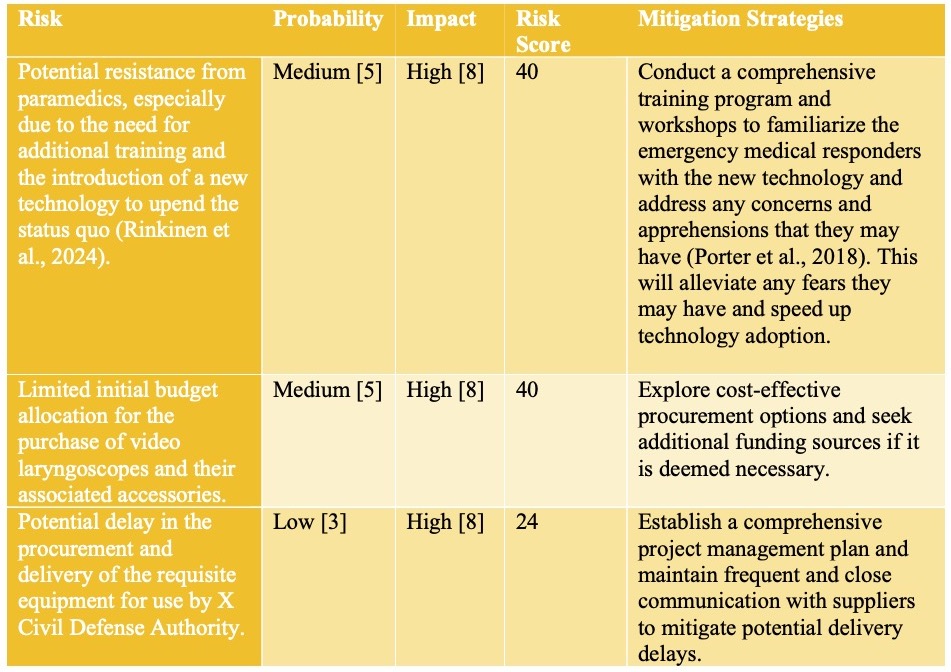
The video laryngoscope intervention will initially be implemented in five EMS stations within the X Civil Defense Authority. This pilot implementation will enable evaluation and refinement before considering a full adoption across all 13 stations. The adoption of a pilot implementation strategy is recommended, as it significantly reduces uncertainty when introducing a new device or method (Khan et al., 2020). Additionally, it contributes to more accurate risk estimation, as shown in Table 2, thereby increasing the project’s viability.
Smart Objectives
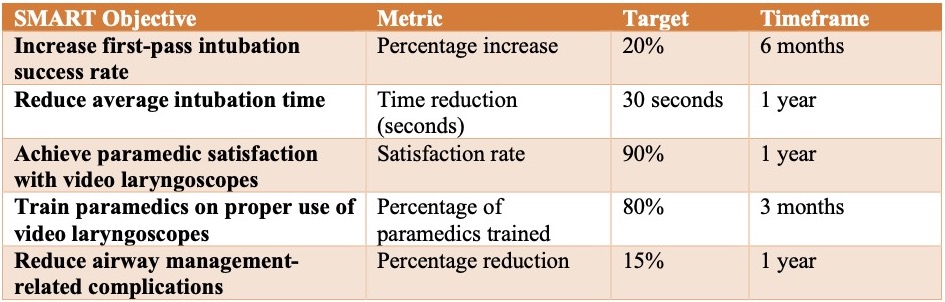
Table 1: SMART Objectives
Risk Assessment Matrix (RAM)
Table 2: Risk Assessment Matrix
Budget Impact Analysis
This business case concerns the implementation of a project to introduce video laryngoscopes at at least 5 stations under the jurisdiction of X Civil Defense Authority. This project will take 12 months from the day that the project team is created. The target population is residents of the UAE, especially those in the five stations that will receive the new device. Currently, EMS teams in these areas are issued with conventional laryngoscopes, which are inherently riskier for patients.
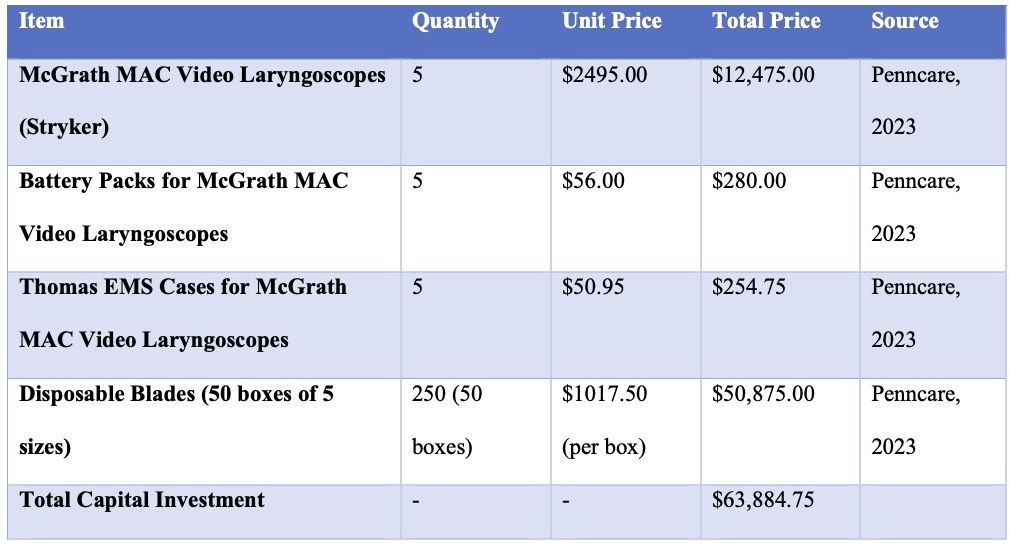
The adoption of the video laryngoscope in X Civil Defense Authority will require a massive initial outlay in equipment and training. However, the expected savings and benefits, including improved patient outcomes, increased efficiency, and reduced complications, will offset these costs over time (Hu et al., 2021). Below is a breakdown of the costs and benefits associated with the authority’s adoption of a video laryngoscope.
Implementing this project will increase efficiency, efficacy, and patient safety. Specifically, video laryngoscopes will save time during intubation. Additionally, they will make it easier for EMS personnel to visualize the trachea and vocal cords, reducing the risk of intubation. Further, the project will reduce intubation-related complications, thereby lowering overall healthcare costs.
Capital Investments
Table 3: Capital Investments
Operating Expenses
Table 4: Year 1 Projected Operating Expenses
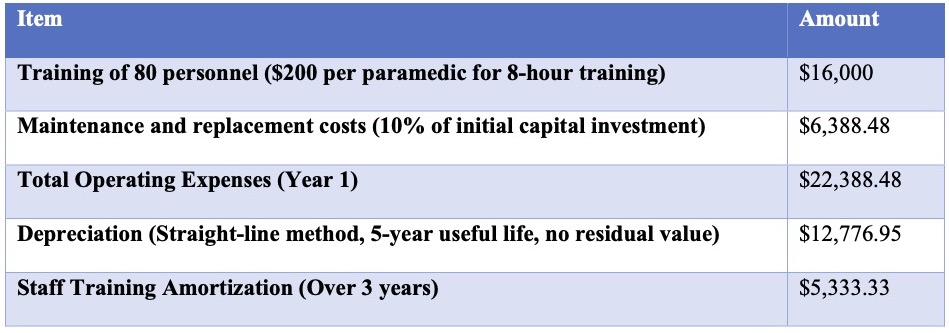
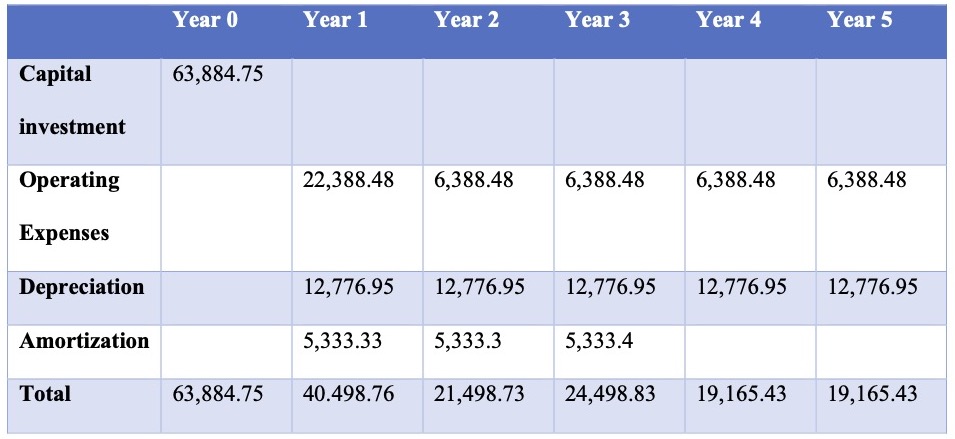
In the first year of the project’s implementation, the following operating expenses are expected. Training of 80 personnel on the operation and maintenance of the video laryngoscopes (estimated at $200 per paramedic for an eight-hour training program). The training expenses will be capitalized and, as such, will require annual amortization in line with accounting standards.
Maintenance and replacement costs for video laryngoscopes are estimated at 10% of the initial capital investment annually, to account for accessories, repairs, and equipment replacements. In addition to the operating expenses, the equipment and corresponding accessories will be depreciated and amortized. For this business case study, the useful life of the video laryngoscopes will be assumed to be five years. The depreciation will use the straight-line method and assume no residual value. Additionally, staff training will be amortized over 3 years.
Table 5: Five-Year Capital and Operating Expenses
Potential Cost Savings
The X Civil Defense Authority’s implementation of video laryngoscopes is expected to reduce airway-management-related complications and associated costs. In particular, the SMART objectives outlined in Table 1 require a 15% reduction within the first year. Achieving this objective will yield potential cost savings for the authority. For example, if the average cost of treating a complication is $10,000, the incidence rate across the authority is 10%, and the average is 5,000 intubations annually, the potential savings for the year will be $75,000. Such savings often lead to lower healthcare costs.
Additionally, increased efficiency in airway management due to faster, more successful intubation. Reduced on-scene times will allow paramedics to respond to more calls, improve overall resource utilization, and, in turn, increase operational efficiency (Vithalani et al., 2022; Ajith et al., 2022). Additionally, this project will lead to improved patient outcomes, enhanced quality of care, and reduced downstream healthcare costs. The device’s adoption across the five main stations will help reduce healthcare costs by preventing complications that often lead to extended hospital stays and long-term care requirements.
Therefore, while the initial investment is massive, the potential benefits to the X Civil Defense Authority and the thousands of individuals it serves will pale in comparison to these costs. Given the authority’s strategic objective of providing high-quality, efficient emergency medical services, the project will be a game changer. Its potential benefits in terms of patient safety, clinical outcomes, and operational efficiency will eventually outweigh the capital investment and associated operational costs, especially when potential cost savings and enhanced resource mobilization are considered.
Conclusion
A shift from traditional to video laryngoscopes represents a significant technological revolution by the X Civil Defense Authority, especially in the provision of emergency medical services. This technology will address the limitations of the conventional devices that were in use across all thirteen stations when they are eventually rolled out across the board. As such, it will enhance airway management, increase intubation success rates, reduce complications, and ultimately improve health outcomes for the citizenry they serve.
Additionally, the financial and budget analysis highlights the costs the authority will incur when implementing this project. Despite the massive initial investment, the potential benefits for patients and the authority in general far outweigh any cost concerns. Furthermore, this project aligns with the X Civil Defense Authority’s strategic objective of providing advanced and efficient EMS care to the citizens of the UAE. With this new technology, the authority will be able to address critical aspects of emergency care and move closer to achieving its objectives.
However, the successful implementation of this project will require adopting a change management strategy that entails training paramedics to use the new technology, robust project management, and effective communication. Additionally, given that it is a pilot project, frequent and continuous evaluation and monitoring of its impact and the key performance index will be necessary to ensure long-term success.
Thus, the proposed intervention represents a significant step toward modernizing X Civil Defense Authority’s emergency medical services. It will improve patient care and increase EMS efficiency. While the initial outlay is massive for such a small device and its accessories, the potential benefits pale in comparison and align with the organization’s strategic objectives, justifying the intervention.
Reference List
Ajith, P. et al. (2022) ‘Direct Laryngoscope Versus McGrath video-laryngoscope for tracheal intubation in trauma emergency: A randomized control trial’, The American Journal of Emergency Medicine, 56, pp. 353–355.
Brown, C.A. et al. (2020) ‘Video laryngoscopy compared to augmented direct laryngoscopy in adult emergency department tracheal Intubations: A national emergency airway registry study’, Academic Emergency Medicine, 27(2), pp. 100–108.
Gadek, L. et al. (2021) ‘Direct vs. video-laryngoscopy for intubation by paramedics of simulated COVID-19 patients under cardiopulmonary resuscitation: A randomized crossover trial’, Journal of Clinical Medicine, 10(24).
Hu, B., Tian, T. and Xue, F.-S. (2021) ‘Tracheal intubation with video laryngoscopy in out-of-hospital sitting‘, Scandinavian Journal of Trauma, Resuscitation and Emergency Medicine, 29(1).
Khan, H., Richards, M. and Agama, R. (2020) Complete Guide to Pilot Implementation Strategy, Welp Magazine.
Liu, D.-X. et al. (2019) ‘Intubation of non-difficult airways using video laryngoscope versus direct laryngoscope: A randomized, parallel-group study’, BMC Anesthesiology, 19(1).
Nedunchezhian, V., Nedunchezhian, I. and Van Zundert, A. (2023) ‘Clinically preferred video-laryngoscopes in airway management: An updated systematic review’, Healthcare, 11(17).
Pacelli, J. (2022) Corporate tax in the UAE, KPMG.
Penn Care (2024) Video laryngoscope, McGrath Mac Handle, Penn Care, Inc.
Perkins, E.J. et al. (2022) ‘The use of video laryngoscopy outside the Operating Room: A Systematic Review’, PLOS ONE, 17(10).
Porter, A. et al. (2018) ‘Implementation and use of computerized clinical decision support (CCDS) in emergency pre-hospital care: A qualitative study of paramedic views and experience using strong structuration theory’, Implementation Science, 13(1).
Rinkinen, T., Kinnula, M. and Nordquist, H. (2024) ‘Technological development roles and needs in pre-hospital emergency care from the Advanced Level Paramedics’ perspective‘, International Emergency Nursing, 73.
Saul, S.A., Ward, P.A. and McNarry, A.F. (2023) ‘Airway management: The current role of video laryngoscopy’, Journal of Personalized Medicine, 13(9).
Tithecott, A. (2023) In review: The Healthcare Framework in United Arab Emirates, Lexology.
Vithalani, V. et al. (2022) ‘Quality Management of Prehospital Airway Programs: An NAEMSP position statement and Resource Document’, Prehospital Emergency Care, 26(sup1), pp. 14–22.
