
Different tools can be utilized to enhance diverse processes within a healthcare facility. One such instrument is the fishbone diagram (FD), also known as the cause-and-effect or Ishikawa graph, which is employed to identify potential root causes associated with an issue (Nash et al., 2019). A quality improvement initiative that can be managed using FD is reducing wait times (WTs) for patients, although implementing the changes is likely to be challenging across various system levels.
Graph 1 below depicts an FD populated to examine the matter of WTs. The presented FD demonstrates a variety of causes that are likely to result in increased WTs based on the parameters suggested by Nash et al. (2019) as possible categories within such a diagram. For example, a patient may have to wait due to computer issues, which slow down the work, or because of an increased number of people seeking help as a result of an emergency. The proposed FD can be used to help with WTs by indicating several factors that may have led to prolonged WTs. Upon analyzing every element, healthcare facilities can devise a plan to address problems and provide more effective assistance.
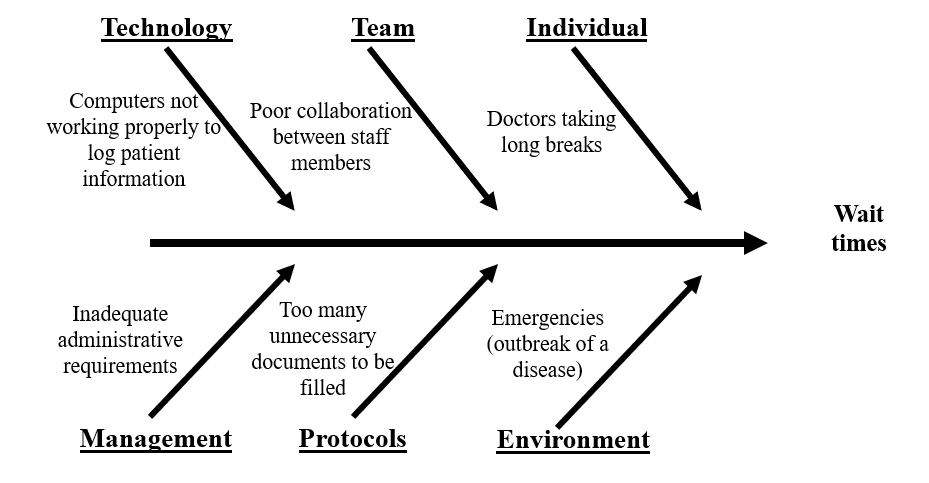
Nonetheless, some concerns and difficulties may occur when applying the FD instrument. On the one hand, healthcare workers and those in managerial positions may not share their respective conceivable deficiencies or may not trust that the other party is being honest about its hindrances (“A framework,” 2005). On the other hand, several key challenges in disseminating the changes brought by the tool can be identified.
First, on level A, which focuses on the individual patient, some people may increase WTs if they are not informed enough to communicate their needs efficiently. Second, regarding rank B, which refers to the care team, staff members may not view a lack of cooperation as a cause behind increased WTs and thus may not be willing to make changes. Third, in terms of level C, which is the organization, the management may not be ready to modify specific requirements that are likely overcomplicated but viewed as safety necessities. Finally, in grade D, which concerns the environment, there are multiple elements that a hospital cannot control because of politics or emergencies (“A framework,” 2005). Consequently, fully implementing FD requires consideration of various concerns and systemic challenges.
References
A framework for a systems approach to health care delivery. (2005). National Center for Biotechnology Information.
Nash, D. B., Joshi, M. S., Ransom, E. R., Ransom, S. B. (2019). The healthcare quality book: Vision, strategy, and tools. AUPHA Press.
