
Abstract
This paper investigates and compares the antacid properties of four commercial drugs: Gaviscon, Omeprazole, Tums Ultra, and Mylanta. Using the addition of hydrochloric acid at Bromocresol Purple indicator, the detergency of each of the antacids is evaluated. The results show that Gaviscon has a distinguishable enhanced efficacy, whereas the potency of Omeprazole, Tums Ultra, and Mylanta is equivalent. The laboratory results are generally supported by published evidence, but the paper describes some discrepancies. The findings indicate that the antacid properties of commercially available drugs differ.
Introduction
Some of the most common pathologic and disease states in the body are gastrointestinal disorders. According to Wang et al. (2023), digestive diseases should be considered as a current threat to safety and health, leading to a significant reduction in quality of life or even death. Internal tissues of the stomach can synthesize hydrochloric acid, a mineral compound with a low pH, and can break down organic matter. Although hydrochloric acid is part of the normal functioning of the stomach, its imbalance leads to an abnormal pH of the stomach and, consequently, to the development of pathologic conditions.
The solution to the problem of altered pH can be carried out through drug therapy. Drugs capable of equalizing the acidity of the gastric environment are called antacids (Ayensu et al., 2020). Given the different compositions and the large number of antacids available, the question is to investigate the efficacy of such drugs comparatively. Four available drugs — Gaviscon, Omeprazole, Tums Ultra, and Mylanta — were used in the present laboratory work. Each of the named drugs has unique physical properties and chemical composition; hence, comparing the clinical efficacy between them is meaningful.
The independent variable is the type of antacid analyzed, represented by four values. The dependent variable is the number of drops of hydrochloric acid that are added to the solution of the medication to lead to a lowering of the pH. The lab work is based on the hypothesis that of the four medications, at least one will be more effective than the others in restraining pH changes. The null hypothesis was that the efficacy of all the drugs would be identical.
Materials and Methods
Four antacid drugs were used for the experiment in the present laboratory work. To ensure the reliability of the comparative study, exactly one dose was taken for each drug. For liquid Gaviscon and Mylanta, 1 reported dose of the substance (1 tablespoon) was dissolved in 100 mL of DI water. For Omeprazole, one solid tablet was converted to powder by mechanical processing and dissolved in 100 mL of DI water. A similar procedure was carried out for Tums Ultra solid tablets. Additionally, pure distilled water was used as a negative control.
The procedure was based on adding HCl in small amounts to each solution to detect changes. Bromocresol Purple was used as an indicator of reduced pH (Hudson-Heck et al., 2021). Five mL of each solution was transferred into labeled test tubes, after which a few drops of the indicator were added to each — each of the solutions (and water) was colored purple.
One drop of 1.0M hydrochloric acid was added to each of the test tubes in turn, and if the solution color did not change to yellow, the number of drops of acid added was added. Ten minutes were used to check if the color of the solution remained the same, after which the color of the solution was checked and recorded.
Results
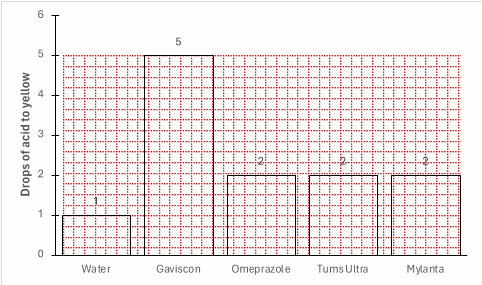
Table 1 below contains the results of the test’s direct measurements. The general rule of thumb for ranking was that the highest number of acid drops added was equivalent to the best efficacy score and vice versa. Figure 2 depicts the experiment’s results as a bar chart. Gaviscon had a different performance, and the onset of pH below seven occurred only after the addition of five drops of acid, while the other three drugs had identical performance.
Table 1: Results of the experiment conducted
Discussion and Conclusion
The results showed that Gaviscon had an increased efficacy as it required 2.5 times more acid drops to lower pH than Omeprazole, Tums Ultra, and Mylanta. This allows to accept the experimental hypothesis and indicates that Gaviscon has the best antacid properties among the other drugs in the study. This can be supported by the findings of Ayensu et al. (2020), who stated that liquid antacids are more effective than solid antacids because of their dispersed form.
Angotoeva et al. (2022) showed that a treatment regimen containing Gaviscon resulted in faster symptom relief in patients compared to Omeprazole. Meanwhile, data from Chung et al. (2021) indicated that Tums is more effective than Gaviscon in restraining the medium’s acidity. The discrepancy may be explained by the authors using acetic acid instead of hydrochloric one to simulate gastric juice conditions.
The results indicate that there are differences in efficacy among commercially available antacids that should be taken into consideration. Differences in chemical composition and cost may be factors in the decision, and the patient should keep in mind that some antacids do a better job of relieving symptoms than others. Although this work has been completed successfully, as an extension, repeated trials could be suggested to reduce bias and simulate more realistic gastric conditions.
References
Angotoeva IB, Loranskaya ID, Kosyakov SY. 2022. A comparative, randomized, uncontrolled study of the effectiveness of two regimens for the treatment of clinical manifestations of laryngopharyngeal reflux without esophageal symptoms. Pharm. 29(10): 68-72.
Ayensu I, Bekoe SO, Adu JK, Brobbey AA, Appiah E. 2020. Evaluation of acid neutralizing and buffering capacities of selected antacids in Ghana. Sci. Afr. 8: 1-7.
Chung S, Habib M, Lin S, Ouyang S. 2021. Comparing the effectiveness of non-synthetic remedies to commercially produced antacids in combating acid reflux. Exped. 11: 1-18.
Hudson-Heck E, Liu X, Byrne RH. 2021. Purification and physical–chemical characterization of Bromocresol purple for carbon system measurements in freshwaters, estuaries, and oceans. ACS Omega 6(28): 17941-17951.
Wang R, Li Z, Liu S, Zhang D. 2023. Global, regional, and national burden of 10 digestive diseases in 204 countries and territories from 1990 to 2019. Front. Public Health. 11: 1-10.
